11 Woe to them! For they have followed the error of Balaam and Korah.
12 These people ruin your feasts by feeding themselves. They are waterless clouds.
fruitless, twice-dead trees, plucked up by their roots.
13 They are waves foaming with their own shame, wandering stars in the blackest of skies.
14-15 Enoch, the seventh from Adam, prophesied about them, saying,
The Lord is coming with 10,000 saints to punish everyone, especially the ungodly for their ungodly deeds which they have ungodly committed, and for their hard speeches which ungodly sinners have spoken against him.
There will be mockers in the last days (following their own ungodly lusts)
16 They are murmurers and complainers, walking after their own lusts.
17-18 Remember the words of the apostles that said there'd be mockers in the last days, who would follow their own ungodly lusts.
19 These people would separate themselves, and be sensual, not spiritual.
20 But keep your most holy faith by praying in the Holy Ghost.
Save people with fear (and hate garments soiled by the flesh)
22 Some make a difference by having some compassion.
23 Others save people with fear, pulling them out of the fire, hating the garments that are soiled by the flesh.
From Jude, the brother of James to all true believers. (1)
The author claims to be the brother of James, who most likely refers to James, the brother of Jesus. So the author is claiming to be the brother of James and Jesus, since according to the gospels of Matthew (13:55) and Mark (6:3), Jesus had a brother named Jude (or Judas, which is just another version of the same name) .
But it is unlikely that the author was Jesus's brother - for the usual reasons. Jude, if he was the brother on James and Jesus, would have been from a poor Galilean family, would have spoken Aramaic, and would not have been able to write a letter in Greek. Jude was also written near the end of the first century, long after the Jesus's family would have died.
There is, however, some disagreement about whether the Apostle Jude was also the brother of Jesus. When the apostles are listed in Luke (6:16) and Acts (1:13), he is called Judas of James - which is sometimes translated as Judas the son of James and sometimes as the brother of James (as does the KJV). So some say the Apostle Jude was Jesus's brother and some do not.
To make things even more confusing, Jude is not listed as an apostle in Matthew (10:1-4) or Mark (3:16-19). The missing Jude is replaced with a Thaddeus, who believers assume is just another name for Jude (to avoid having 13 apostles).
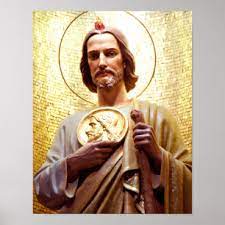
And then, of course, there is Saint Jude - the patron saint of impossible causes. He is usually shown holding a coin with Jesus's face on it, with a flame on top of his head.
Remember how the Lord saved the people from Egypt and then destroyed those who didn't believe? (5)
This refers to the story in Numbers (14:1-35) where God wanted to kill all of the Israelites during the Exodus for complaining. But Moses talked him out of it. So God decided to kill all of them slowly instead - all the soldiers anyway - over a period of 38 years or so. DWB: God slowly killed the Israelite army
And God imprisoned the angels who left their homes with everlasting chains and darkness until the judgment on the great day. (6)
This refers to story about the sons of God having sex with the daughters of men in Genesis 6:1-4, which is greatly expanded on in 1 Enoch, Chapters 6-19.
Sodom and Gomorrah committed fornication by going after strange flesh. (7)
There is much debate about the meaning of this verse. Does the phrase "going after strange flesh" refer to women having sex with angels (or sons of God), or does it refer to the men of Sodom asking to have sex with Lot's guests - who appeared to be men?
See A note about the "strange flesh" of Jude 7 in Strange Flesh: The Bible and Homosexuality.
Even Michael the archangel when he argued with the devil about the body of Moses (9)
He cometh with ten thousands of His holy ones to execute judgement upon all, and to destroy all the ungodly: and to convict all flesh of all the works of their ungodliness which they have ungodly committed, and of all the hard things which ungodly sinners have spoken against Him.